
Dynamic Inventory & Multi-Warehouse Stock Management System
Business Problem
The Operational Bottleneck
Retail and distribution enterprises operating multiple warehouses and physical outlets struggled with fragmented stock visibility. Disjointed spreadsheet tracking and legacy inventory tools resulted in inaccurate product counts, painful stock discrepancy reconciliations, expensive excess carrying costs, and lost sales due to unmonitored stock depletion.
Fragmented Multi-Warehouse Stock Visibility & Disconnected Data
• Warehouse supervisors and store managers operated on siloed local spreadsheets with no centralized stock database.
• Headquarters lacked real-time visibility into exact SKU quantities across distribution centers and physical retail stores.
• Customer orders were delayed or canceled due to false 'out-of-stock' alerts while surplus inventory sat idle in neighboring hubs.
• Procurement teams operated without live stock data, leading to miscalculated replenishment budgets and stock imbalance.
Manual Order Management & Costly Stockout / Overstocking Cycles
• Stock replenishment orders were placed manually based on guesswork rather than real-time consumption velocities.
• Fast-moving seasonal merchandise frequently sold out, resulting in missed sales opportunities and frustrated retail customers.
• Slow-moving inventory accumulated unnoticed in secondary warehouses, incurring steep storage fees and obsolescence risks.
• Supplier purchase orders lacked automated approval routing and digital status tracking, extending procurement cycle times.
Uncontrolled Stock Discrepancies, Shrinkage & Lack of Reconciliation
• Physical warehouse counts regularly clashed with registered bookkeeping numbers without identifiable root causes.
• Damaged, expired, or lost items were removed from shelves without standardized adjustment logs or supervisor approvals.
• Auditors spent days investigating stock variances during quarterly checks, unable to trace who made manual inventory changes.
• Lack of granular reference tracking prevented management from detecting systematic product theft or transit damages.
Slow & Inflexible Inter-Store / Inter-Warehouse Stock Transfers
• Transferring inventory between warehouses required tedious phone calls, email requests, and manual paper waybills.
• Items in transit frequently vanished into informational black holes without status tracking or expected arrival timestamps.
• Destination warehouses often received partial or incorrect shipments with no systematic way to verify received goods.
• High inter-warehouse shipping expenses accumulated due to unoptimized, ad-hoc stock redistribution routes.
Absence of Unified Real-Time Financial Telemetry & Executive Insights
• Business leadership lacked an executive dashboard visualizing monthly purchase volumes against incoming sales revenues.
• Expired and near-expiry goods languished on shelves because managers had no proactive automated warning system.
• Generating inventory valuation and turnover velocity reports required days of error-prone spreadsheet compilation.
• Executives were unable to forecast cash flow requirements or make data-driven purchasing decisions with confidence.
Business Benefits
High-Yield Strategic Impact
Deploying the dynamic Inventory and Stock Management System replaced guesswork with precision control, giving leadership centralized command over multiple warehouses, eliminating stock discrepancies, and drastically reducing operating expenses.
35% Reduction in Inventory Carrying & Operational Costs
• Accurate real-time stock visibility eliminated surplus inventory purchases and cut unnecessary warehouse storage costs.
• Optimized stock redistribution between facilities slashed expensive emergency replenishment orders from suppliers.
• Automated digital workflows eliminated paper-based inventory tracking and saved hundreds of administrative labor hours.
• Decreased expired product write-offs by 60% through proactive shelf-life telemetry and early clearance triggers.
99.7% Real-Time Inventory Tracking & Stock Accuracy
• Synchronized database updates ensure physical warehouse bins precisely mirror digital system stock records.
• Granular adjustment logging with supervisor sign-offs eliminated untracked product shrinkage and theft across facilities.
• Warehouse staff locate SKUs and batch variants instantly, accelerating fulfillment picking speeds by over 45%.
• Enterprise auditors conduct quarterly inventory reconciliations in hours rather than weeks with zero count discrepancies.
75% Faster Inter-Warehouse Stock Transfer Turnaround
• Digital stock transfer orders automatically route through sender dispatch, in-transit tracking, and receiver receipt.
• Clear shipping fee recording and reference documentation maintain complete financial accountability for every transit leg.
• Store locations rebalance regional stock in hours, fulfilling customer orders from the nearest warehouse without delays.
• Real-time transit telemetry gives logistics coordinators full visibility into shipment progress and transit bottlenecks.
Zero Stockouts with Proactive Low-Stock & Reorder Alerts
• Automated threshold monitoring alerts warehouse operators the moment SKU quantities drop below safety buffers.
• One-click reorder generation pre-populates purchase orders with preferred vendor pricing and historical batch volumes.
• High-demand retail items maintain optimal availability during peak holiday shopping and promotional campaign periods.
• Customer satisfaction and repeat purchase loyalty increased significantly due to dependable, on-time product availability.
Complete Financial Transparency & Actionable Executive Telemetry
• Executive dashboards display live financial KPI telemetry comparing monthly purchase investments against sales income.
• Instant visibility into recent stock activity, expired items, and top-selling SKUs empowers swift executive decisions.
• Role-based permissions safeguard sensitive cost data while granting staff appropriate operational access.
• Empowered procurement leaders with historical purchasing trends to negotiate bulk vendor discounts with confidence.
Solution Overview
DivyamStack designed and implemented a full-stack, enterprise-grade Inventory & Stock Management System leveraging ASP.NET Core, Entity Framework Core, C#, Microsoft SQL Server, and Angular. Featuring an intuitive executive dashboard, real-time multi-warehouse stock monitoring, granular stock adjustments, automated inter-warehouse transfers, and comprehensive financial reporting, the solution streamlines end-to-end warehouse logistics and maximizes operational profitability.
Key Platform Features
Deep-dive into the technical capabilities engineered for this deployment.
Centralized Executive Dashboard & Financial Telemetry
The platform's command center delivers a high-level executive view of the entire inventory lifecycle across all facilities. Key metrics such as total purchase cost, total sales revenue, purchase dues, and invoice totals are displayed in interactive telemetry cards. Visual bar charts track purchase and sales financial velocity over monthly periods, allowing management to evaluate liquidity at a glance. Dedicated data widgets highlight expired products requiring immediate clearance and list recently added items with their unit prices, stock quantities, and timestamps for comprehensive operational transparency.
Multi-Warehouse Stock Monitoring & SKU Variant Control
Warehouse supervisors maintain complete control over hundreds of SKUs across distinct regional storage hubs and physical stores. The Manage Stock module displays real-time inventory counts categorized by product category, warehouse location, and individual product variants. Authorized personnel can quickly open the Edit Stock modal to modify product codes, warehouse designations, batch numbers, and on-hand quantities with instant SQL persistence. Built-in search filtering and pagination allow operators to pinpoint any specific SKU in seconds, ensuring rapid order fulfillment and picking accuracy.
Granular Stock Adjustment & Damage Reconciliation
To eliminate untracked product shrinkage and reconcile physical counting variances, the system features a dedicated Stock Adjustment module. Warehouse managers can record stock additions or reductions with explicit reference tags, product codes, and timestamps. The Edit Adjustment modal allows supervisors to document the exact rationale—such as packaging damage, factory defects, laboratory quality testing, or routine shelf replenishment. Every adjustment requires authenticated credentials, creating an immutable audit trail that safeguards the business against inventory loss.
Inter-Warehouse Stock Transfer & Transit Logistics
Facilitating seamless stock rebalancing across multiple distribution hubs, the Stock Transfer system eliminates manual paper waybills and communication delays. Operators initiate stock movements through the Add Transfer modal, selecting source and destination warehouses, target items, quantities, and associated shipping costs. The system tracks transfer statuses from pending dispatch to in-transit and received, ensuring chain-of-custody integrity throughout shipping. Automated quantity adjustments prevent stock duplication while goods are moving between facilities.
Proactive Low-Stock Alerts & Automated Reorder Workflows
The platform continuously monitors inventory levels against customizable minimum and maximum buffer thresholds for each SKU. When quantities dip below safe operational levels, the system alerts procurement managers with proactive notifications and dashboard indicators. Procurement teams can instantly generate supplier purchase orders with pre-filled supplier agreements, preferred unit pricing, and batch specifications. By automating replenishment triggers, the system prevents costly stockouts and maintains continuous product availability across retail channels.
Enterprise Role-Based Security & Compliance Auditing
Built on ASP.NET Core and Entity Framework Core, the platform enforces strict role-based access control (RBAC) across organizational tiers. Administrators can grant tailored permissions to warehouse floor workers, store managers, procurement specialists, and executive financial auditors. Sensitive wholesale costs, supplier agreements, and profit margin metrics are restricted to authorized personnel, preventing internal data leaks. Complete transaction logs record every login, stock update, transfer approval, and adjustment, guaranteeing audit readiness for regulatory compliance.
Project Preview Images
Click any preview image to enlarge in full-resolution view.
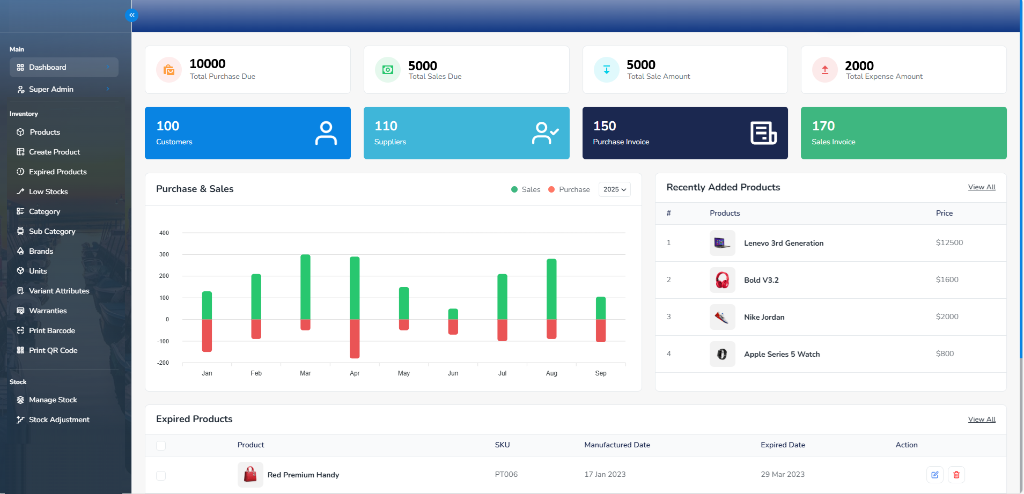
Executive Inventory Dashboard with KPI Telemetry, Purchase vs Sales Analytics, and Expired Products Table
Click to expand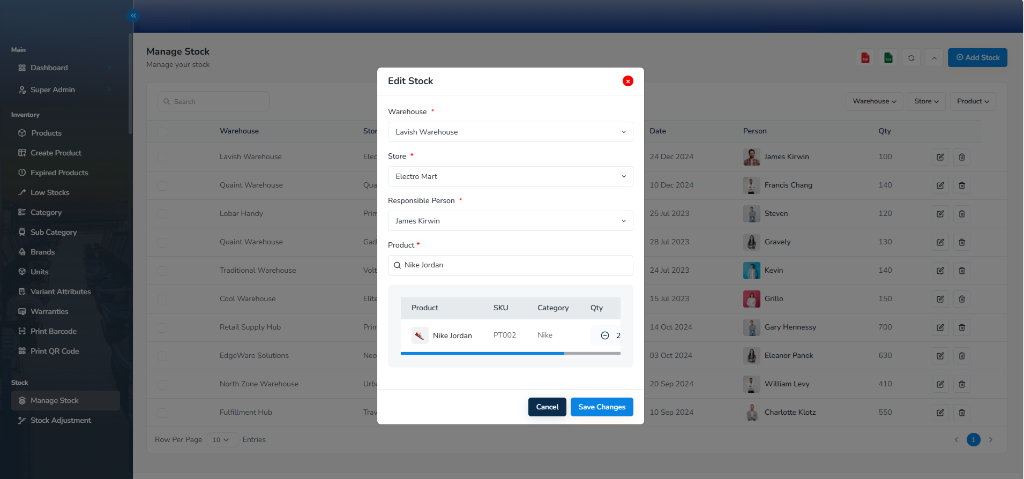
Manage Stock Interface with Real-Time Multi-Warehouse Quantity Editing and SKU Variant Control
Click to expand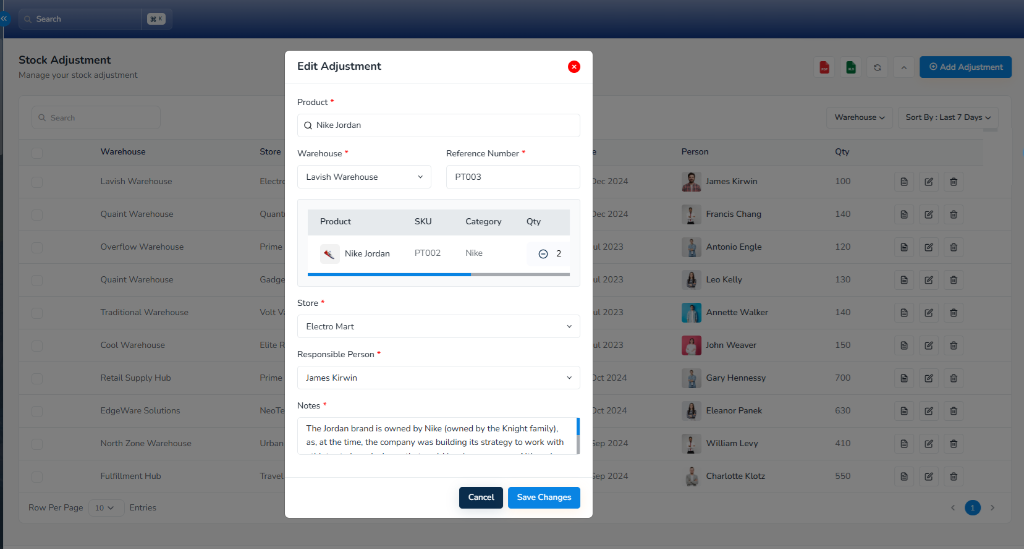
Stock Adjustment Modal for Recording Discrepancies, Damaged Inventory, and Reference Notes
Click to expand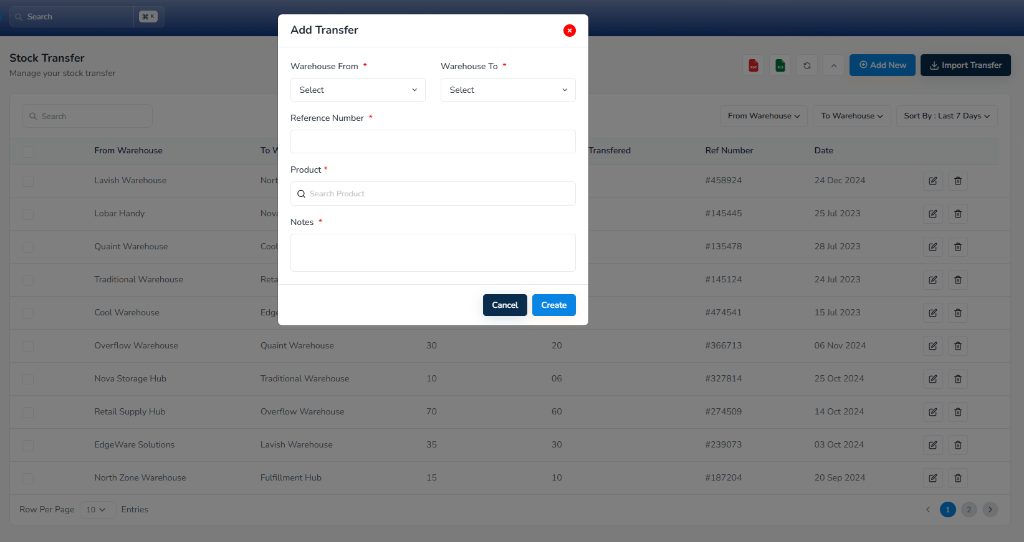
Inter-Warehouse Stock Transfer Creation with Source/Destination Routing and Shipping Cost Tracking
Click to expandTechnology Stack
Enterprise tools, languages, and cloud infrastructure leveraged to build and maintain the solution.
ASP.NET Core Web API
C#
Entity Framework Core
Microsoft SQL Server
Angular & TypeScript
Tailwind CSS
Chart.js & Telemetry
RESTful Web APIs
Ready to achieve similar scalable results for your enterprise?
Schedule a technical consultation with our engineering leaders to discuss system architecture, modernization, or bespoke product development.