
ClinicKare - Intelligent Healthcare Management Platform
Business Problem
The Operational Bottleneck
Operating an expanding healthcare chain across 8 outpatient clinics created severe operational gridlock. Relying on disconnected physical ledgers, desktop spreadsheets, and chaotic WhatsApp groups paralyzed staff productivity, degraded the patient experience, and exposed the business to substantial financial leakage.
Fragmented Multi-Branch Patient Records & Clinical Blind Spots
• Each branch maintained isolated appointment books with zero cross-clinic synchronization.
• Doctors had no real-time visibility into incoming patient queues or clinical medical histories.
• Patients visiting a different clinic branch had to manually recount their diagnoses from scratch.
• Medical staff frequently prescribed treatments without knowledge of prior allergic reactions.
Alarming 30% Appointment No-Show Rate & Idle Clinical Capacity
• With only ad-hoc, manual reminder calls made by overloaded receptionists, no-shows climbed to 30%.
• Empty appointment slots left highly specialized physicians idle for hours during scheduled shifts.
• No automated system existed to dynamically backfill cancellations from eager waitlisted patients.
• Each unoccupied time slot represented irrecoverable clinical overhead and operational loss.
Manual Billing Inefficiencies, Revenue Leakage & Discrepancies
• Invoices were hand-typed into desktop spreadsheets with inconsistent rates for consultation fees.
• Pharmacy sales, diagnostic lab charges, and split patient payments were loosely recorded in notebooks.
• Reconciling multi-branch monthly income took senior accounting personnel three full working days.
• Discrepancies between physical cash collected and recorded ledger entries were routinely discovered.
Prolonged Consultation Cycles & Hand-Written Prescription Errors
• Physicians spent up to 6 minutes per consultation handwriting paper prescriptions and notes.
• Pharmacists routinely struggled to decipher messy handwriting, causing medication dispensing delays.
• No automated drug interaction or allergy cross-checking existed during the prescription process.
• Patients regularly waited over 45 minutes in clinic lobbies just to collect paper scripts.
Zero Real-Time Operational Analytics for Executive Leadership
• Clinic owners and medical directors operated in the dark without daily performance telemetry.
• Leadership could not determine which branches were profitable or which medical specialties lagged.
• Staff scheduling decisions were made on gut feeling rather than objective patient volume patterns.
• Identifying systemic bottlenecks required tedious manual audits that arrived weeks too late.
Business Benefits
High-Yield Strategic Impact
By implementing ClinicKare, the clinic network eliminated administrative friction, elevated patient retention, and achieved sustainable profitability across all 8 branches within the first 6 months of deployment.
73% Reduction in Patient No-Shows
• Automated two-way WhatsApp and SMS reminders kept patients informed of upcoming consultations.
• Intelligent gap-filling automatically offered last-minute cancellations to waiting patients within minutes.
• Doctor utilization rates surged to 94%, ensuring clinical hours generated maximum productive value.
• The clinic recovered hundreds of previously lost appointment hours every single month.
Zero Billing Inconsistencies & Instant GST Compliance
• Standardized point-of-sale invoicing unified consultation, pharmacy, and diagnostic lab pricing.
• Every transaction automatically generates a compliant GST invoice with instant PDF export capabilities.
• Accounts reconciliation time plummeted from three full days to under 2 hours per billing cycle.
• Revenue leakage across all 8 multi-specialty outpatient clinics was completely eradicated.
22% Monthly Revenue Growth Per Clinic Branch
• Optimized patient throughput enabled clinics to serve more consultations without hiring extra staff.
• Integrated in-house pharmacy and lab ordering increased cross-departmental service conversions.
• Real-time patient follow-up prompts ensured chronic care patients returned for routine evaluations.
• Predictable patient scheduling turned underperforming clinic locations into profitable branches.
3+ Hours Saved Daily Per Branch in Staff Labor
• Reception staff were completely freed from the burden of dialling hundreds of reminder phone calls.
• Digital token displays in waiting areas smoothly routed walk-ins without staff calling out names.
• Automated check-ins and self-serve reschedule links cut front-desk administrative queues in half.
• Clinical receptionists redirected their focus toward providing personalized on-site patient hospitality.
Sub-30-Second WhatsApp Digital Prescription Delivery
• Doctors generate structured digital prescriptions with drug autocomplete in under 60 seconds.
• Secure, digitally signed PDF prescriptions are dispatched to the patient's WhatsApp before they exit.
• Pharmacy counters instantly receive the electronic prescription queue for rapid preparation.
• Eliminated dispensing errors caused by illegible doctor handwriting with automated allergy alerts.
Solution Overview
DivyamStack architected ClinicKare as an enterprise multi-tenant SaaS healthcare operating system on AWS. Built using Blazor WebAssembly (.NET 10) for a responsive front-end experience and ASP.NET Core 10 Minimal APIs with SQL Server for backend performance, the platform enforces strict data isolation per clinic branch while giving executives real-time cross-branch visibility.
Key Platform Features
Deep-dive into the technical capabilities engineered for this deployment.
Intelligent Multi-Provider Scheduling & Token Engine
The scheduling engine provides custom calendar slots tailored to each physician's consultation duration, rest breaks, and patient quotas. Walk-in patients receive dynamic digital tokens with real-time waiting room TV queue display updates. When an appointment is cancelled within 2 hours of its start time, the algorithm automatically pings waitlisted patients via WhatsApp with an instant one-click claim link, recovering what would have been lost provider revenue. Machine learning algorithms analyse historical patient attendance patterns to recommend appointment windows with the highest probability of on-time arrival.
Omni-Channel Automated Patient Communications
ClinicKare integrates directly with the Twilio WhatsApp Business API and SMS gateways through an event-driven messaging service. Automated notification workflows guide patients from initial booking confirmation to 24-hour advance reminders and 2-hour queue estimates. Upon consultation completion, the system immediately solicits structured 1-to-5 star patient satisfaction reviews and triggers scheduled follow-up reminders. This proactive communication loop eliminated manual phone reminders while maintaining patient satisfaction ratings above 4.6 out of 5 stars.
High-Speed Blazor Digital Prescription & Safety Engine
Physicians interact with an ultra-responsive Blazor WebAssembly interface designed specifically for fast tablet and desktop entry during live consultations. A curated database of 18,000+ pharmaceutical formulations provides sub-100ms autocomplete with dosage and course frequency suggestions. The ASP.NET Core backend validates drugs against recorded patient allergies in real time, preventing adverse drug reactions before prescriptions can be saved. Upon signature, the system compiles a branded, digitally signed PDF prescription and instantly delivers it to the patient's WhatsApp.
Point-of-Sale Clinical Billing & GST Management
The unified financial module combines outpatient consultation charges, in-house pharmacy items, and external diagnostic tests into a single invoice. It calculates regional GST splits automatically, generates itemised fiscal summaries, and supports multi-modal split transactions including cash, UPI, and insurance claims. Partial dues and outstanding balances are systematically tracked against the patient's unique master health record, preventing unauthorized write-offs. All transaction data streams directly into accounting reports without requiring manual Excel consolidation.
Real-Time SignalR Executive Intelligence Dashboard
Medical directors and executive leaders gain comprehensive oversight across all 8 branches through real-time dashboards powered by ASP.NET Core SignalR. The interface displays live appointment flow states, revenue per clinical specialty, doctor wait times, and branch capacity utilization with zero page reloads. Embedded machine learning models flag operational anomalies, such as unexpected cancellation spikes or pharmacy inventory shortages, allowing proactive intervention. Executive leadership can securely review multi-clinic operational performance from mobile devices anywhere in the world.
HIPAA-Aligned Multi-Tenant Security & Tenant Isolation
ClinicKare implements enterprise schema-per-tenant data isolation on AWS RDS SQL Server to ensure clinical records are partitioned between clinic branches. Sensitive patient health records and personal contact information are encrypted at rest using Always Encrypted technology and in transit via TLS 1.3. Role-based access control (RBAC) powered by ASP.NET Core Identity ensures receptionists, doctors, pharmacists, and accountants only access data relevant to their role. Audit logging records every record access and prescription modification, satisfying strict medical regulatory standards.
Project Preview Images
Click any preview image to enlarge in full-resolution view.
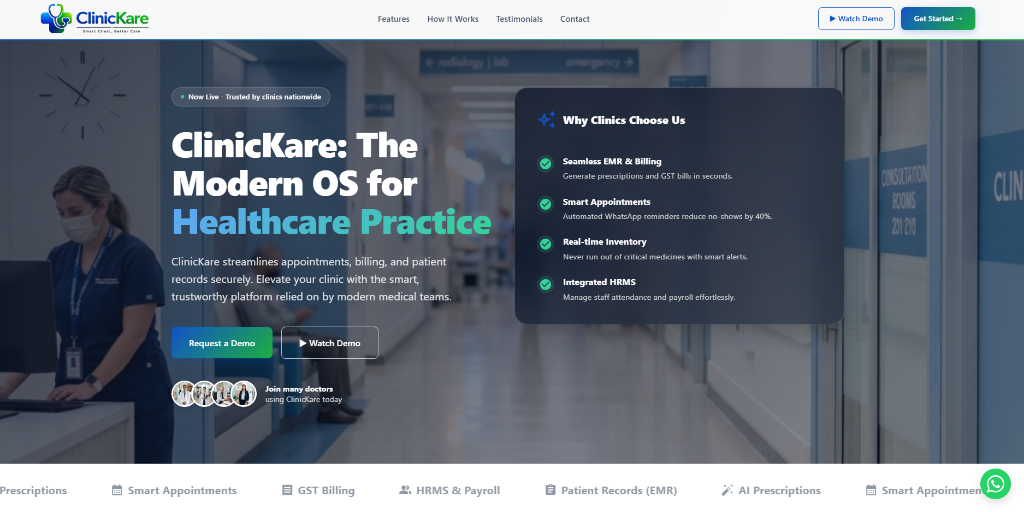
ClinicKare Modern OS for Healthcare Practice Landing Page & Comprehensive Feature Overview
Click to expand
ClinicKare Enterprise Superadmin & Medical Staff Role-Based Secure Sign-In Portal
Click to expand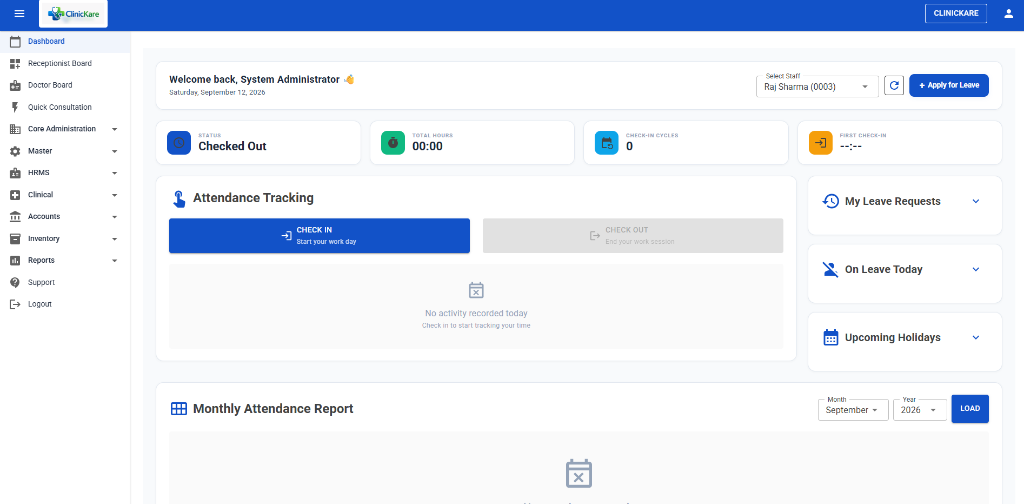
System Administrator Dashboard with Real-Time Staff Attendance Tracking, HRMS & Clinical Boards
Click to expand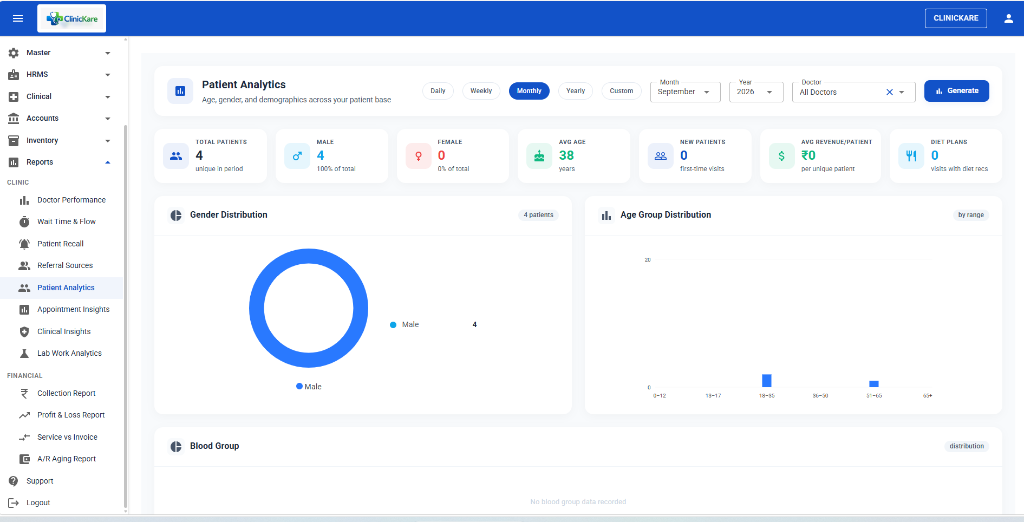
Interactive Patient Analytics Telemetry with Demographics, Doctor Performance & Financial Reports
Click to expandTechnology Stack
Enterprise tools, languages, and cloud infrastructure leveraged to build and maintain the solution.
Blazor WebAssembly (.NET 10)
ASP.NET Core 10 Minimal APIs
Microsoft SQL Server
Azure OpenAI & Semantic Kernel
Twilio WhatsApp & SMS API
AWS ECS Fargate & S3
Docker & GitHub Actions
SignalR Core
Ready to achieve similar scalable results for your enterprise?
Schedule a technical consultation with our engineering leaders to discuss system architecture, modernization, or bespoke product development.